
How Zen Technologies Built One of India’s Most Focused Defence Patent Portfolios
There is a single sheet of paper, filed on 28 February 1995, sitting inside the records of the Indian Patent Office. The applicant is written down as Zen Technologies and Computers Limited. The two inventors are Midathala Ravi Kumar and Kishore Dutt Atluri. The invention is easy to describe in one line. It is a mechanical grenade simulator that lets soldiers practice throwing grenades without using real ones.
Filed the same day, right next to it, is a second application. Same inventors, same company. This one covers a device for training people to use small arms. It is a mechanical rig with sensors fitted to a rifle, so a new recruit can practice aiming and firing without live rounds.
Both were granted. Both carry patent numbers, IN188135B and IN188136B, that still show up in the company records today.
That is where the Zen Technologies story starts. Not with a big vision statement or a large funding round, but with two engineers in Hyderabad who felt there had to be a better way to train soldiers.
The Company Behind the Patents
Zen Technologies Limited was set up in 1993 in Hyderabad, Telangana. The first name of the company was Zen Technologies and Computers Limited. It was started by Ashok Atluri and Kishore Dutt Atluri, along with co-founder Ravi Midathala. Ashok Atluri is today the Chairman and Managing Director. Kishore Dutt Atluri is the President and Joint Managing Director.
The company went public in 2000 on the Hyderabad Stock Exchange. It then listed on the Bombay Stock Exchange in March 2011 and on the National Stock Exchange on 30 March 2015, where it trades under the ticker ZENTEC.
For its first ten years, Zen worked away from the spotlight. It supplied training simulators to the Indian armed forces and police and put almost all of its effort into making soldier training cheaper, safer, and easier to repeat than live firing on a range. The tank simulator business grew into a strong position at home over time and reached around 95 percent share of that product category.
The patent activity tells a richer story though. It shows how the company has changed over the years, where it is putting its research effort now, and what the recent buyouts are really adding in terms of technical strength.
What the Full Portfolio Actually Looks Like
The full patent dataset runs from 1995 through July 2026 and holds 224 records across the Zen group. These cover granted patents, pending applications, design registrations, and a set of older filings that have since lapsed or been withdrawn. The live part of the portfolio, meaning patents that are either granted or still being examined, comes to just over 164 records. Sixty have lapsed or been dropped.

Seven separate legal entities hold patents in the group. The parent, Zen Technologies Limited, owns 144 of the records. The other 28 are spread across the subsidiaries and related companies. Aituring Technologies holds 11, Vector Technics 9, Unistring Tech Solutions 4, Bhairav Robotics 2, Trishula Advanced Composites and Electronics 1, and Zen Medical Technologies 1.
Did you know Zen Technologies have 15+ subsidiaries currently 7 subsidiaries along with Zen Technologies contributing in patent filing but in upcoming time rest of other subsidiaries play in role of patent filing.

When you look at what the patents actually protect, the portfolio falls into 18 technology groups. The four biggest by count are target systems for shooting ranges with 23 patents, tank and vehicle crew training simulators with 19, laser systems for training and targeting with 18, and firearms training simulators with 17. Heavy weapons simulators, which cover mortars, grenades, rocket launchers, and artillery, add another 17. Motion platforms, the moving mechanical bases that shift a simulator around to make it feel real, account for 14 more.
Write us to get the complete list of subsidiaries of Zen Technologies –

Added up, the training and simulation categories make up the large majority of the portfolio, somewhere around 120 of the 172 families depending on how you count recoil systems and range gear. The clearly operational hardware, meaning drones, weapon stations, cameras, and robots, is a much smaller and much newer slice of about 36 families, nearly all of it filed since 2023
The Filing Timeline and What It Reveals
Looking at when the patents were filed tells a clearer story than the headline numbers do.
The first two filings landed in February 1995. Nothing more came in until July 2001, when five applications went in around small arms simulators and a recoil generation system. A multipoint position sensing application followed in August 2001, and in 2002 the company tried an Australian filing on that positioning work, which it later pulled back.
From 2006 to 2010 the filings grew slowly but steadily. The motion platform work started in this stretch, with the founding motion platform patent, IN262172B, filed in June 2006. By 2010, Zen was filing six applications in a single year, most of them covering recoil mechanisms that are still live in the portfolio.
The busiest run by pure volume was 2011 to 2013, with 33 filings across those three years. The company was building out its target system designs and its shipping container shooting range ideas, many of them paired with design registrations to protect the way the hardware looked.
From 2014 to 2021 the pace eased off. The company was settling around its simulator lines and starting to take some patents abroad through the PCT route.
Then came 2022 with 16 filings. Then 15 in 2023. Then 24 in 2024. Then another 16 in the first half of 2025 on its own. The filing rate has more than doubled in three years, and just as important, the subject matter has shifted a lot.

Are you wondering why there is a drop in patent filing for the last two years? It is because a patent application can take up to 18 months to get published. Certainly, it doesn’t suggest a decrease in the patent filing.
Do read about some interesting highlights of the: India’s Drone Industry Patent Landscape (2015-2026).
The Inventors Behind the Work
Three people from the founding years of Zen Technologies account for most of the patent output across the whole history of the portfolio.
Kishore Dutt Atluri is a named inventor on 86 of the 172 innovations. That is exactly half the company output carrying one person’s name. Midathala Ravi Kumar appears on 37 Innovations. Samson Jayaprakash Agna, another long serving engineer, appears on 14. Between these three, most of the early work in simulation, laser systems, motion platforms, and target detection filed from 1995 through about 2020 is covered.

Venkatapathi Raju Nadempalli, on 7 patents, stands for the more recent laser work, in particular the built in laser unit designs and beam steering systems filed in late 2024.
The subsidiary buyouts have brought in fresh inventor groups. Karna Mahendra Raj leads the Vector Technics side with 9 patents on drone propellers and motors. Tushar Namdev Hindlekar and Komal Deepak Bhangale at Aituring Technologies, with 8 patents each, are behind the remote controlled weapon station and surveillance camera work. Srinivasa Raju Kolahalam at Unistring Tech Solutions accounts for all four of the electronic warfare and counter drone patents from that entity. At Bhairav Robotics, Naga Ramakrishna Rao Commuri and Sai Shravanth Orvakal are behind the military robotics filings.
This is worth paying attention to in any IP review. Buyouts often look better in a press release than they turn out to be in the patent data, where a bought company sometimes shows a thin or stale portfolio. That is not the case here. Each of the four subsidiaries is actively producing new filings in 2024 and 2025, under inventor teams that are separate from the parent company core group. The bought portfolios add real weight rather than just filling out a slide.
The Training Simulation Foundation
The heart of the Zen IP estate is its training simulation portfolio, and to understand it you have to see how carefully it was put together, step by step.
The 1995 grenade throwing aid and the small arms trainer were purely mechanical. By 2001 the company had moved on to adding sensors and electronics, filing patents on the interactive small arms training simulator and the recoil generation system that went with it. Recoil simulation grew into its own line of work, with patents covering air powered recoil parts, sensing the exact moment the trigger is pulled, modified blank cartridge systems, and pulling all of it together into physical feedback that feels convincing to the trainee.
By 2010 and 2011 the laser work was taking shape. Zen filed on a laser transmitter unit, a way of encoding messages into a focused laser beam, and systems for boresighting, which is the job of lining up a weapon sight with where the shot actually lands. Boresighting patents kept building through 2016 and into 2024, with the newest one covering adjustable beam steering for merged visible and infrared laser output.
The grenade simulator line is worth following on its own to see what steady development really looks like in patent terms. The 1995 filing was a mechanical training aid. By 2006 there was a much improved version, IN415389B. By 2010 the multi mode hand grenade simulator, IN549056B, was filed, covering both offensive and defensive modes with a pyrotechnic cartridge for a realistic effect. By 2015 a grenade simulator with a new trigger approach, IN434216B, was filed. By 2019 came a full automatic grenade launcher simulator system, IN571595B. The multi shot grenade launcher followed in the same year. Each new version added electronic sensing, software control, and better physical realism. The grenade line on its own, seven patents across three decades, shows the depth of work sitting behind what might look from the outside like a narrow little product.
Tank and vehicle crew simulation is even wider. The gearbox simulator, IN283250B, filed in January 2008, and the steering mechanism, IN283798B, also filed in January 2008, covered the physical controls inside a vehicle simulator. Both were taken abroad through PCT and produced European, Australian, and US family members. The driving training system patent, IN371463B, filed in October 2012, reached South Africa. The container based crew gunnery simulator family, filed together in March 2022 across four separate applications, covered the gunner cabin, the commander cabin, the motion platform, and the instructor station as distinct inventions. That gives layered protection over what is now one of the company flagship product lines.
The motion platform work is both technically special and backed up abroad. The founding motion platform, IN262172B from 2006, has now expired. Its follow on, filed in 2009 as IN1408CHE2009, was granted in the United States as US10373513B2 in August 2019 and carries four forward citations, the highest citation count in the whole Zen portfolio. Four other patent applicants pointed back to the Zen motion platform in their own later filings, which is the clearest sign in this dataset that an outside party found the work technically useful. In a portfolio where no other patent carries more than two citations, four really stands out.
The Laser Systems
Eighteen patents cover laser systems, running from a basic laser transmitter unit all the way up to some genuinely tricky optical engineering.
The laser transmitter unit, IN501929B, filed in September 2015, is a base piece. It uses two parallel laser beams, one visible for bore sighting and one infrared to stand in for live ammunition, both run by a microcontroller. The product logic holds up well. A soldier using a simulator rifle needs a visible dot to line things up, while the system uses an unseen infrared beam to log the shot electronically. From there the laser work grew into alignment mechanisms, the built in laser unit holder, IN501164B from 2021, and designs for the physical housing and alignment parts.
The most recent filings are the most demanding. In November 2024 Zen filed three related applications on built in laser units that merge a visible and an infrared beam into one output. One covers the laser unit itself, IN585737B, now granted as of April 2026. One covers the long pass optical filter that makes the beam merging possible in the first place, a part made from BK7 glass with alternating layers of silicon dioxide and titanium dioxide laid down by ion beam sputtering, IN567935B, granted in July 2025. The third covers the beam steering system with precision adjustment mirrors that can correct the angle by finer than a tenth of a degree per turn, IN202441093199A, filed in November 2024 and still under examination. These three together protect a full subsystem rather than one part, which points to a more mature way of filing.
The Move Into Working Hardware
The four years from 2022 to 2026 mark the clearest turning point in the portfolio. For most of its life Zen filed on training simulation. Now it is filing on weapons, surveillance, drone hardware, electronic warfare, and military robotics, all of them technologies where the real world use is operational rather than for teaching.
Aituring Technologies, bought with a 51 percent stake in February 2024, has produced 11 patents entirely since the middle of 2024. Four cover remote controlled weapon stations. There is an ultralight ground vehicle mount, a tank mounted station for armoured platforms, an auto tracking version, and a naval system for hitting targets as far out as two kilometres. All of them are still pending. The inventor team is large, with nine named inventors across the main filings, which points to a mixed skill group rather than one or two specialists.
Six of the Aituring patents cover surveillance cameras. These include a thermal and visual imaging system, a long range multi sensor optical platform, a rugged camera built for mounting on an armoured vehicle, and a pan and tilt surveillance system with AI based object tracking. Several are also backed by design registrations, so the physical shape of the hardware is protected alongside the technology inside it.
The one Aituring filing that is neither a weapon nor a camera is the armed four legged robot, IN202421094119A, filed in November 2024. It covers a walking robot with LIDAR, a depth camera, optical cameras, high torque motors, and an AI control system that can find its own path and track targets on its own, with the option to fit a weapon. It is in examination.

Vector Technics, bought with a 51 percent controlling stake in February 2025, has filed nine patents in one tight burst. Five propeller applications went in on the same day in May 2025. Three motor related applications went in during February and April 2025. The propeller work is very specific. It covers blade shapes tuned for airflow, tip vortex designs that cut drag and noise, folding joint mechanisms that open on their own under spinning force, carbon fibre reinforced polymer build with UV stabilisers, and a computing setup that ties airflow simulation to manufacturing quality checks.
The motor patents cover a cooling system for outrunner brushless DC motors, an internally damped motor with rubber like isolation to cut running noise, and an electro mechanical flywheel with a built in generator rotor. A design patent on the physical shape of the propeller, IN461655001S, was granted in September 2025.
Unistring Tech Solutions became a Zen subsidiary in 2019, which makes it the earliest of the buyouts and the one with the longest track record inside the group. Its four patents are all in electronic warfare and signal intelligence. The oldest and most developed is the drone mounted radar target simulator that uses digital radio frequency memory, IN398047B, filed in July 2020 and granted in June 2022. This system uses a drone to throw out realistic radar returns and train radar operators without needing real aircraft.
The FPGA based time frequency phase synchronisation system, IN415356B, filed in June 2021 and granted in December 2022, covers beamforming used in radar and communication arrays. The machine learning based pulse detection system for signal interception, IN202341050980A from July 2023, is still pending. The newest Unistring filing, an autonomous aerial interception system for physically grabbing hostile drones, IN202641069197A from June 2026, is the newest filing in the whole portfolio.
Bhairav Robotics, an associate company with a 45.33 percent stake bought in February 2025, has two filings. The six legged military robot, IN202441039725A, filed in May 2024, mixes hydraulic power with two onboard computers for finding its way and dodging obstacles across rough ground. The stereo vision and machine learning system, IN202541044721A, filed in May 2025, works out the distance and location of several targets at once using cameras and GPS, without giving off any active signal that could reveal where the robot is.

International Coverage That Is Small but Deliberate
Zen Technologies does not file abroad just to show a global footprint. Set against the 168 records it holds in India, the overseas side of the portfolio is small but chosen with care, about 39 records spread across 11 countries and regions.
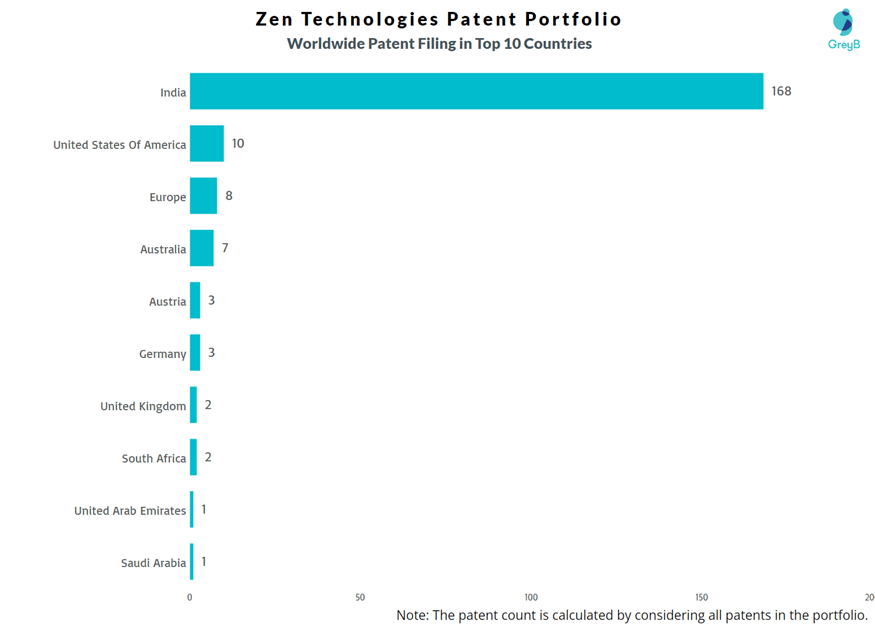
The United States leads with 10, followed by Europe with 8 and Australia with 7. Austria and Germany have 3 each, the United Kingdom and South Africa have 2 each, and Malaysia, Indonesia, the United Arab Emirates, and Saudi Arabia have 1 each. Most of these are older cases that have since lapsed. Around 13 are still live today, and almost all of those sit in the United States and Europe, the markets where the company has real export interest.
Conclusion
So what does thirty years of filing add up to? A portfolio that is deep where it counts and honest about what it is. The training simulation work is not a handful of product patents but a whole stack, the recoil parts, the laser units, the target detection, the motion platforms, and the simulator cabins, built one piece at a time by a small core of engineers who are still filing today. That is IP earned through steady work, not bought off a shelf.
The last three years show a company shifting gears. The filing rate has more than doubled since 2022, and the subject has moved past training into working hardware, drones, weapon stations, cameras, and robots. Much of that new work is coming from the companies Zen has picked up since 2019, and the patent data shows those buyouts are pulling their weight, each one still producing fresh filings under its own engineering team rather than sitting idle.
Two things are worth watching from here. One is how far the operational hardware push goes, since it is still young and mostly unexamined, and its real value will only be clear once those applications start to grant. The other is the heavy reliance on the founding inventors, with one name on half of everything the company has ever filed. A firm this ambitious will need the next generation of inventors to step forward if the IP engine is going to keep running at this pace.
Put all of it together and the picture is of a company that knew what it was for from the very first filing and has never lost the thread. From a mechanical grenade trainer in 1995 to an AI guided drone catcher three decades later, the tools kept changing and the mission never did. That kind of focus is rare, and in a field as demanding as defence, it is the thing most likely to keep paying off.
Curious Who’s Winning the Defence Innovation Race?
This article reveals how Zen Technologies built its patent portfolio. But the bigger question is: how does it compare to the rest of the defence industry?
Request a Competitive Patent Portfolio Analysis


