
LG Electronics leads the U.S. drone patent race as innovation shifts toward imaging, connectivity, computing and autonomous drone operations.
More than 46,000 drone-related patent applications appear in the analysed U.S. dataset between 2015 and July 2026. Over the longer term, patent activity has expanded significantly, but the more important story is how the competitive landscape has changed.
The companies accumulating drone-related IP are no longer limited to traditional aerospace companies or UAV manufacturers. LG Electronics leads the portfolio with 2,417 patents, followed by Samsung Electronics with 2,154 and Qualcomm with 2,069. DJI, despite being one of the most recognizable drone manufacturers globally, has 481 patents in the analysed U.S. portfolio.
This means the U.S. drone patent race is increasingly being influenced by companies controlling the technologies surrounding the aircraft communications, semiconductors, imaging, connectivity, computing and autonomy not only by companies manufacturing drones.
The international dimension is equally notable. Twenty-two of the top 50 patent filers are foreign companies, showing that the U.S. remains an important IP market for global drone and enabling-technology players.
Recent patent activity strengthens this picture. During 2025–July 2026, innovation is concentrated in imaging, edge computing, connectivity, mapping, RF technologies, AI and autonomous operations. At the same time, emerging clusters around Counter-UAS, BVLOS fleet operations and predictive maintenance indicate that the industry is moving toward a new challenge: making drones safe, persistent and scalable enough for increasingly autonomous commercial and defense operations.
The analysis also identifies government interest across approximately 3% of the portfolio, one patent flagged in the dataset as standards-essential, and 20 patents involved in 37 litigation cases, 21 of which remain open.
Related analysis: India’s Drone Industry Patent Landscape (2015-2026)
Methodology and Scope
This analysis covers U.S. drone-related patent records from 2015 through July 2026. Company and inventor rankings are presented as patent counts, while the recent technology, emerging-technology and opportunity analyses use unique patent families.
Technology-area analysis covers activity during January 2025 to July 2026, and 2026 should therefore be treated as a partial year rather than compared directly with completed calendar years.
How Has U.S. Drone Patent Activity Changed Since 2015?

The long-term trajectory shows substantial expansion. Annual application counts in the supplied dataset increased from 840 in 2015 to 3,751 in 2025, equivalent to approximately 16.14% annualized growth over the decade.
But the CAGR alone hides a more important change in the market.
Patent activity climbed rapidly through the second half of the 2015 and reached 6,558 applications in 2022, the highest annual level in the dataset. It then moved to 6,494 in 2023, 5,635 in 2024 and 3,751 in 2025.
That makes 2022 an important inflection point rather than simply another year in a continuously rising curve.
The decline after 2022 should not automatically be interpreted as a collapse in drone innovation. Patent data can be affected by publication and prosecution timing, and the final interpretation will depend on the year field used in the underlying analysis. What the data does show clearly is that the explosive expansion visible during the earlier period has not continued at the same rate.
The grant trajectory also behaves differently. Grants increased from only 7 in 2015 to 3,900 in 2025, while the partial 2026 dataset already contains 3,463 grants. This divergence between application and grant counts likely reflects patents filed in earlier years moving through prosecution and should not be treated as a same-year application-to-grant conversion rate.
U.S. Drone Industry Annual Patent Publications (2015-2026)
| Year of Patents Filing or Grant | USA Drone Applications Filed | USA Drone Patents Granted |
| 2026 | 293 | 3463 |
| 2025 | 3751 | 3900 |
| 2024 | 5635 | 3072 |
| 2023 | 6494 | 2397 |
| 2022 | 6558 | 1794 |
| 2021 | 5569 | 1419 |
| 2020 | 5081 | 1409 |
| 2019 | 4360 | 1310 |
| 2018 | 3409 | 652 |
| 2017 | 2861 | 294 |
| 2016 | 2081 | 65 |
| 2015 | 840 | 7 |
Who Is Leading the U.S. Drone Patent Race?
Top 50 Companies in U.S. Drone Industry
The corporate rankings reveal one of the most important findings in the landscape: drone patent leadership does not mirror drone market visibility.
LG Electronics leads with 2,417 patents, followed by Samsung Electronics with 2,154 and Qualcomm with 2,069. Sony, Amazon, Nvidia, Boeing and Intel also appear among the leading filers.
DJI, by comparison, has 481 patents in the analysed portfolio. LG’s count is therefore roughly five times DJI’s.
That gap changes how the competitive landscape should be interpreted.
The most important holders of drone-related intellectual property may not necessarily be the companies selling the greatest number of UAV platforms. Consumer-electronics companies, semiconductor companies and connectivity specialists can build large portfolios because modern drones depend on technologies such as imaging, communications, positioning, sensing, computing and autonomous decision-making.
For freedom-to-operate and competitive-intelligence teams, this means limiting surveillance to drone OEMs could leave substantial parts of the relevant IP landscape unmonitored.
| Company | Patents | Industry |
| LG Electronics | 2417 | Consumer Electronics |
| Samsung Electronics | 2154 | Consumer Electronics |
| Qualcomm | 2069 | Semiconductors / Wireless Technology |
| Sony | 805 | Consumer Electronics |
| Amazon | 755 | E-commerce / Cloud Computing |
| Nvidia | 722 | Semiconductors / AI Computing |
| Boeing | 691 | Aerospace & Defence |
| Intel | 667 | Semiconductors |
| Toyota | 590 | Automotive |
| General Motors | 564 | Automotive |
| IBM | 487 | IT & Enterprise Technology |
| DJI | 481 | Drones / Aerial Robotics |
| At&T | 448 | Telecommunications |
| Hyundai | 397 | Automotive |
| Honeywell International | 389 | Industrial Technology / Aerospace |
| Textron | 381 | Aerospace & Defence |
| Kia Corp | 367 | Automotive |
| T-Mobile | 344 | Telecommunications |
| Apple | 333 | Consumer Electronics |
| Interdigital | 327 | Wireless Technology / Patent Licensing |
| Canon | 299 | Imaging & Optics |
| Ford Motor | 280 | Automotive |
| Beta Air Llc | 273 | Electric Aviation (eVTOL) |
| Here Global Bv | 271 | Mapping & Location Technology |
| Nippon Telegraph And Telephone Corp | 263 | Telecommunications |
| John Deere | 247 | Agricultural Machinery |
| Panasonic | 241 | Consumer Electronics |
| Nec Corp | 240 | IT & Telecommunications |
| Huawei | 239 | Telecommunications |
| Ericsson | 231 | Telecommunications |
| Rivian | 229 | Electric Vehicles (Automotive) |
| Micron Technology Inc | 227 | Semiconductors (Memory) |
| Alarm.Com Inc | 214 | Smart Home / IoT Security |
| 206 | Internet Services / Technology | |
| Verizon | 204 | Telecommunications |
| Nokia | 200 | Telecommunications |
| State Farm | 197 | Insurance |
| Skydio | 192 | Drones / Aerial Robotics |
| Bae Systems | 191 | Defence & Aerospace |
| Motorola | 185 | Telecommunications / Consumer Electronics |
| Waymo | 178 | Autonomous Driving |
| Walmart | 176 | Retail |
| Microsoft | 167 | IT & Software / Cloud Computing |
| Honda Motor | 160 | Automotive |
| Autel Robotics | 160 | Drones / Aerial Robotics |
| United States Department of the Navy | 148 | Defence (Government/Military) |
| Robert Bosch | 139 | Automotive Components / Industrial Tech |
| Toshiba | 132 | Consumer Electronics / Industrial Tech |
| Largan Precision Co Ltd | 108 | Optics & Camera Lenses |
| Aramco | 96 | Oil & Gas / Energy |
Foreign Companies Are Playing a Major Role in U.S. Drone IP
Foreign companies account for 22 of the top 50 filers in the analysed portfolio.
LG Electronics and Samsung Electronics occupy the first two positions overall, while other prominent foreign companies include Sony, Toyota, DJI, Hyundai, Kia, Canon, NTT, Panasonic, NEC, Huawei, Ericsson and Nokia.
This foreign participation is strategically important because it shows that U.S. patent protection is being pursued aggressively by companies whose primary R&D or commercial base may lie outside the country.
It also reinforces the cross-industry nature of drone innovation. The foreign leaderboard contains consumer-electronics companies, automotive manufacturers, telecommunications businesses and drone manufacturers rather than a single dominant industry category.
For U.S.-focused patent teams, competitor monitoring therefore needs to account for global assignees entering the drone ecosystem through enabling technologies, not only direct UAV competitors.
Key Foreign Players

U.S. Companies Are Strongest in Enabling Technologies
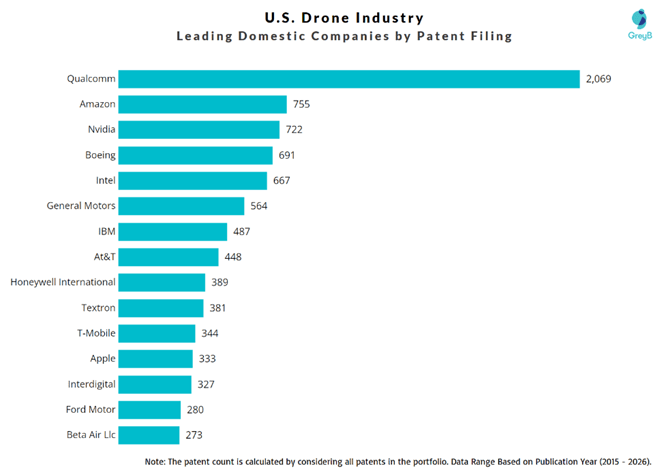
Among domestic players, Qualcomm leads with 2,069 patents, followed by Amazon with 755, Nvidia with 722 and Boeing with 691.
Intel, General Motors, IBM, AT&T, Honeywell, Textron, T-Mobile, Apple, InterDigital and Ford also appear among the leading domestic filers.
The composition is more strategically revealing than the ranking itself.
Only a portion of these companies would traditionally be classified as drone manufacturers. Many instead operate in semiconductors, wireless communications, cloud computing, automotive technology, telecommunications, AI, electronics or aerospace systems.
This supports a broader conclusion emerging from the portfolio: competitive advantage in drones is becoming increasingly dependent on the digital and communications stack surrounding the aircraft.
Key domestic Players
Who Are the Leading Inventors in U.S. Drone Patenting?
The inventor landscape is even more concentrated than the corporate leaderboard.
Suckchel Yang leads with 353 patents, followed by Seonwook Kim with 338, Seungmin Lee with 272, Youngdae Lee with 260, Jiwon Kang with 227 and Hanbyul Seo with 215. All six are associated with LG Electronics.

List of Top 25 Leading Inventors by Patent Filing in U.S Drone Industry
Across the top 25 inventors:
- 15 are associated with LG Electronics
- 5 are associated with Qualcomm
- 4 are associated with Samsung
- 1 is associated with IBM
In other words, 24 of the top 25 inventors are concentrated within just three companies: LG, Qualcomm and Samsung.
That concentration provides a more useful competitive signal than the inventor ranking alone.
It suggests that leadership in the portfolio is being supported by identifiable and relatively concentrated corporate R&D groups rather than being distributed evenly across the industry.
For technology-scouting teams, the next useful analytical layer would be to map these inventor clusters against the technologies in which they are filing. Doing so could reveal whether individual R&D groups are building concentrated positions around connectivity, sensing, autonomous systems or other strategically important drone technologies.
| Inventor | Patents | Associated Company |
| Suckchel Yang | 353 | LG Electronics |
| Seonwook Kim | 338 | LG Electronics |
| Seungmin Lee | 272 | LG Electronics |
| Youngdae Lee | 260 | LG Electronics |
| Jiwon Kang | 227 | LG Electronics |
| Hanbyul Seo | 215 | LG Electronics |
| Tao Luo | 193 | Qualcomm |
| Giwon Park | 158 | LG Electronics |
| Junyi Li | 145 | Qualcomm |
| Hyunsoo Ko | 144 | LG Electronics |
| Hyoungju Ji | 130 | Samsung |
| Joonkui Ahn | 129 | LG Electronics |
| Jing Sun | 127 | Qualcomm |
| Xiaoxia Zhang | 126 | Qualcomm |
| Sunghoon Jung | 124 | LG Electronics |
| Haewook Park | 124 | LG Electronics |
| Youngbum Kim | 123 | Samsung |
| Youngrok Jang | 120 | Samsung |
| Hyungtae Kim | 109 | LG Electronics |
| Seungjune Yi | 108 | LG Electronics |
| Changhwan Park | 97 | LG Electronics |
| Peter Gaal | 97 | Qualcomm |
| Sarbajit Kumar Rakshit | 97 | IBM |
| Seunghoon Choi | 97 | Samsung |
| Sukhyon Yoon | 93 | LG Electronics |
Where Is Drone Innovation Happening Now?
Recent patent activity shows that drone innovation is moving beyond basic airframes and flight-control systems.
During 2025-July 2026, the strongest filing activity is concentrated in technologies that help drones see their surroundings, communicate, process information and make increasingly autonomous decisions.
Imaging and optics leads the analysed technology areas with 312 patent families. Edge and network computing, UAV connectivity, mapping and geospatial technologies, RF systems, sensors and AI-related technologies also show substantial activity.
The pattern points toward an important change in the industry’s technology stack: the aircraft remains important, but an increasing share of competitive differentiation is being created by the intelligence and infrastructure surrounding it.

Drone Perception Is Becoming a Major Area of Innovation
Imaging and optics is the largest individual recent technology area, with 312 patent families.
LiDAR, radar and sensor technologies are also among the active areas, alongside AI-based decision systems and mapping technologies.
These technologies should not be viewed independently. Together, they represent different layers of the perception problem: detecting objects, understanding surroundings, locating the aircraft and converting sensor information into operational decisions.
As drones move into environments requiring greater autonomy, the ability to perceive and interpret the environment becomes increasingly important for navigation, inspection, collision avoidance, surveillance and automated mission execution.
For R&D teams, the competitive question is therefore shifting from simply improving individual sensors toward improving how multiple sensing and intelligence technologies work together.
The Competitive Focus Is Shifting Toward the Digital Drone Stack
High activity in edge computing, UAV connectivity, mapping, RF systems and AI indicates that an increasing share of drone innovation is taking place outside the physical aircraft platform.
Modern autonomous drones must continuously communicate, interpret sensor data, understand their location, make decisions and coordinate with other systems.
That requires a technology stack involving:
edge and onboard computing, reliable communications, RF and spectrum management, mapping and localization, perception systems, and AI-based decision-making.
This helps explain why semiconductor, telecommunications and consumer-electronics companies appear so prominently in the corporate patent rankings.
Their drone-related portfolios may provide control over the enabling technologies required to make autonomous UAV systems practical at scale.
Mobility and Agriculture Are Creating Application-Level Patent Activity
Among application-oriented technology areas, eVTOL and advanced air mobility account for 184 patent families, while precision agriculture accounts for 176.
Environmental monitoring and industrial inspection also remain active areas.
The importance of these categories is that they move the patent landscape from technology development toward deployment.
Patent activity is increasingly addressing what drones need to perform commercially valuable missions moving people or goods, inspecting infrastructure, collecting agricultural intelligence and monitoring physical environments.
For R&D organizations, this creates a distinction between competing on the drone platform itself and competing on mission-specific capabilities built around the platform.
Four Emerging Technologies in U.S. Drone Industry Could Shape the Next Phase of Drone Competition

Counter-UAS Is Creating a Parallel Innovation Ecosystem
With 67 patent families, Counter-UAS Detection, Tracking & Mitigation is the largest of the four identified emerging clusters.
Growing drone deployment creates a parallel requirement: organizations must be able to identify, track and respond to unauthorized or potentially dangerous aircraft.
Innovation in this space includes RF-based detection, radar and electro-optical sensing, multi-sensor fusion, drone classification, trajectory prediction, communication disruption, interception and automated threat-response technologies.
Strategic implication
Counter-UAS should increasingly be viewed as an ecosystem adjacent to the drone industry rather than simply as a defensive feature.
As civilian, industrial and defence drone deployments increase, control of the surrounding low-altitude airspace becomes more valuable. That creates potential opportunities not only for UAV manufacturers but also for radar companies, RF specialists, defence contractors and sensor-fusion technology providers.
Advanced Airframe and Propulsion Innovation Is Becoming Mission-Specific
The 54 patent families identified in advanced airframe and aero propulsive design indicate that fundamental aircraft-performance challenges remain unresolved.
Range, payload, endurance, noise, stability and energy efficiency continue to constrain drone deployment.
Recent innovation increasingly involves the interaction between aircraft architecture and propulsion rather than isolated structural changes. Areas include distributed propulsion, rotor optimization, propeller-wing integration, aerodynamic control, lightweight structures, foldable or morphing configurations and technologies for reducing drag or acoustic signatures.
Strategic implication
Future platform differentiation may depend less on creating one universally superior drone and more on creating airframe-propulsion architectures optimized for particular missions.
A long-range inspection platform, urban delivery aircraft and persistent-surveillance UAV face different design constraints. This creates room for mission-specific IP positions even in a comparatively mature hardware landscape.
Autonomous BVLOS Operations Are About Scaling Fleets, Not Just Flying Farther
The 51 patent families associated with autonomous BVLOS fleet and delivery operations point toward one of the most commercially important changes in the drone industry.
Beyond-visual-line-of-sight operation is required for use cases such as long-distance delivery, infrastructure inspection, emergency response, surveillance and large-scale industrial monitoring.
But BVLOS scalability requires much more than autonomous navigation.
Patent activity in this area includes route planning, mission scheduling, fleet coordination, remote supervision, detect-and-avoid technologies, communications redundancy, traffic-management integration, automated dispatch, landing and recovery systems, and multi-drone control.
Strategic implication
The critical economic problem is increasingly becoming how many aircraft one operator can supervise safely and effectively.
Technologies that reduce human intervention per mission can change the operating economics of drone fleets. Companies solving the transition from one-operator-one-drone toward one-operator-many-drones could therefore occupy strategically important positions in commercial UAV infrastructure.
Predictive Maintenance Could Become Part of the Autonomy Stack
Autonomous Health Monitoring & Predictive Maintenance accounts for 42 patent families.
This is smaller than the other three emerging clusters, but its strategic relevance increases as drone fleets become larger and missions become more autonomous.
Traditional manual inspection becomes difficult to scale when operators manage hundreds of aircraft.
Relevant technologies include battery state-of-health estimation, motor and rotor diagnostics, vibration monitoring, sensor fault detection, structural-health monitoring, degradation prediction and remaining-useful-life estimation.
Strategic implication
Drone autonomy is likely to extend beyond navigation.
Future platforms may increasingly need to understand not only where they are and what is around them, but also whether they are healthy enough to complete the next mission safely.
In fleet environments, that capability could allow management systems to identify abnormal battery degradation, motor behavior or sensor performance before failure occurs and automatically remove an aircraft from service.
That turns predictive maintenance from a support function into part of the autonomous operating architecture.
Where Could Lower-Density Drone Innovation Opportunities Emerge?
Potential white space
Analysis of recent U.S. drone patent activity highlights several technology areas that exhibit comparatively lower patent-family concentration while addressing increasingly important technical requirements for autonomous and scalable drone operations. These areas represent potential innovation white spaces, where technological relevance appears to be increasing but patent activity remains relatively less concentrated than in the leading emerging technology clusters.
Seven areas stand out: Autonomous Charging & Energy Replenishment, Autonomous Precision Docking, Autonomous Emergency Response & DFR Systems, Dynamic Airspace Management & Deconfliction, Drone-Enabled Digital Twins & Infrastructure Intelligence, Satellite/NTN Connectivity for BVLOS Drones, and Autonomous Multi-UAS & Swarm Coordination.
Collectively, these areas indicate that future opportunities in the U.S. drone ecosystem may increasingly emerge around the supporting technologies required to make autonomous drone operations persistent, connected, coordinated, and scalable, rather than around the aircraft platform alone.

Government Interest and Standards-Related Activity
Approximately 3% of the analyzed U.S. drone portfolio is flagged as having government interest in the supplied dataset.
This is relevant because government-linked patent activity can reveal technologies being developed for defense, public-safety or federally supported applications that may not be visible through commercial company rankings alone.
The analysis also identifies US11025661B2 as a standards-related/standards-essential patent candidate.
Patent Litigation in the U.S. Drone Landscape
Patent volume shows where companies are building positions. Litigation provides a different signal: where those rights are already creating commercial conflict.
The analysis identifies 20 patents involved in 37 litigation cases, with 21 cases still open.
Perrone Robotics leads the plaintiff landscape with nine cases, followed by Fractal Networks with eight and Koji IP with six.
| Plaintiff Company Names | No of Cases |
| Perrone Robotics Inc | 9 |
| Fractal Networks Llc | 8 |
| Koji IP Llc | 6 |
| Drone-Control Llc | 2 |
| Metarail Inc | 2 |
| Redmon Jeang Llc | 1 |
| PASCO Scientific | 1 |
| Irdeto Bv | 1 |
| SynMax Inc | 1 |
| Autonomous Devices Llc | 1 |
| Appliance Computing III Inc | 1 |
| Ryrusch IP Llc | 1 |
| ETAK Systems Llc | 1 |
| Ouster Inc | 1 |
| Matterport Inc | 1 |
On the defendant side, Renesas Electronics America and Tesla have three cases each, while Google and Hyundai have two each. This corrects the earlier narrative in which Google was described as having three cases despite the supporting table showing two.
The defendant list extends well beyond conventional drone manufacturers. Automotive companies, wireless businesses, technology companies and mapping-related players all appear.
That pattern is consistent with the broader patent landscape: drone-related IP risk increasingly crosses industry boundaries because many relevant patents cover technologies that drones share with connected vehicles, telecommunications, sensing, mapping and autonomous systems
| Defendant Company Names | No of Cases |
| Renesas Electronics America Inc | 3 |
| Tesla Inc | 3 |
| 2 | |
| Hyundai | 2 |
| B+T Group Holdings Inc | 1 |
| Appliance Computing III Inc | 1 |
| Veea Inc | 1 |
| Guru Wireless Inc | 1 |
| Radisys Corporation | 1 |
| Haas Inc | 1 |
| Energous Corporation | 1 |
| Hesai Group | 1 |
| Vernier Software & Technology Llc | 1 |
| Nissan Motor | 1 |
| GAO Tek Inc | 1 |
| Nybsys Inc | 1 |
| Ossia Inc | 1 |
| Kayrros Sas | 1 |
| Redfin Corporation | 1 |
| Kia Corp | 1 |
| SwellPro Technology Ltd | 1 |
| SZ DJI Technology Co Ltd | 1 |
| Toyota Motor | 1 |
| Mazda Motor Corporation | 1 |
| TurnSignl Inc | 1 |
| Miami Labs Inc | 1 |
| Velocix Solutions Limited | 1 |
| Microamp Solutions | 1 |
| Volkswagen | 1 |
| Movandi Corporation | 1 |
| Nippon Telegraph and Telephone Corporation | 1 |
Strategic implication
Freedom-to-operate analysis in drones should therefore not begin and end with patents assigned to UAV manufacturers.
An effective FTO strategy needs to consider adjacent technology owners whose patents may cover communications, sensing, navigation, autonomy or infrastructure used within a drone product or service.
The 21 open cases deserve particular attention because their outcomes may influence licensing positions, market-entry decisions and the interpretation of relevant patent claims.
For IP teams, the next analytical step is not simply counting these disputes but examining the specific patents, asserted claims and technology clusters involved in the open cases.
The remaining open litigation cases and rapidly developing technology clusters can be evaluated at the claim and patent-family level to identify potential freedom-to-operate risks, licensing targets, competitor positions and R&D opportunities before product or technology decisions are made.
Which Universities and Research Institutes Are Filing the Most U.S. Drone Patents?
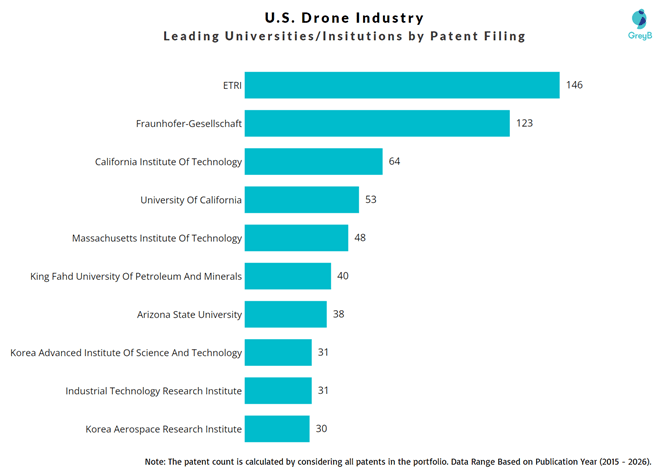
ETRI leads with 146 patents, followed by Fraunhofer-Gesellschaft with 123. California Institute of Technology follows with 64, while the University of California has 53 and Massachusetts Institute of Technology has 48.
The significance is not simply that ETRI and Fraunhofer occupy the top two positions. Both are non-U.S. research organizations seeking protection within the U.S. patent system.
This mirrors the corporate landscape, where foreign organizations also hold substantial positions.
For R&D and technology-scouting teams, university monitoring therefore should not be restricted to domestic institutions. Potential licensing opportunities, research collaborations and early-stage technology signals may emerge from research organizations globally while still being protected in the U.S.
A further useful layer would be to map these institutions against the recent technology clusters to determine which organizations are building positions in perception, autonomy, connectivity, air mobility and other emerging areas.
What the U.S. Drone Patent Landscape Signals for IP and R&D Teams
The most important finding from this landscape is not simply that drone patenting has expanded. It is that the center of competitive IP activity is moving outward from the aircraft itself.
LG, Samsung and Qualcomm’s positions show that leadership in drone-related intellectual property can come from companies controlling electronics, communications and computing technologies rather than from UAV manufacturers alone.
Recent technology activity points in the same direction. Imaging, sensors, connectivity, edge computing, mapping, RF technologies and AI are becoming essential components of the drone innovation stack.
At the same time, emerging areas such as autonomous BVLOS fleet operations, predictive maintenance and Counter-UAS indicate that the next stage of competition will increasingly revolve around operating drones safely, persistently and at scale.
The lower-density technology areas extend the pattern further. Charging, docking, airspace management, satellite connectivity and multi-UAS coordination are all technologies required when drone operations move from individual aircraft toward autonomous systems and fleets.
For patent teams, this changes competitive monitoring. The relevant competitor set now extends beyond drone OEMs to semiconductor companies, telecommunications providers, AI companies, automotive manufacturers, research institutions and other owners of enabling technologies.
For R&D teams, it changes the innovation question as well.
The opportunity may no longer be simply to build a better drone.
It may be to control one of the technologies required to make thousands of drones perceive, communicate, coordinate, maintain themselves and operate autonomously.
Which Patents Could Affect Your Next Drone Product?
The portfolio-level trends are only the starting point. If you are evaluating a new drone technology, entering a market, benchmarking competitors, or planning R&D, the next step is to understand the specific patent families, claims, assignees, and technology overlaps that could affect your strategy.
We can conduct a focused deep dive around your product or technology to identify potential FTO risks, competitor patent positions, licensing exposure, emerging patent clusters, and defensible innovation opportunities.
Where Should Your Next Drone R&D Bet Be?
Lower patent activity does not automatically mean white space. Before allocating R&D resources, it is important to understand whether an emerging area is genuinely open, rapidly becoming crowded, or already controlled by a small group of patent owners.
We can evaluate a specific technology area for patent density, filing momentum, assignee concentration, competitor activity, adjacent IP and potential innovation gaps to help R&D teams prioritize where deeper investigation is justified.


